
Highlights:
16 - 22 November, 2026
New Art Highlights Include: Kay Shah, Thulani Rachia, Rod Dee and Tahereh Asadi
The Return to Rajouri, 2017 by Kay Shah
Rajouri is a district in India and was the original birthplace of my late Grandfather. At the end of the British colonial rule and the subsequent partition of India and Pakistan, in 1947, he relocated from the village of Khankhari, Rajouri, to the then newly-born country of Pakistan. “The Return to Rajouri” symbolises the transition between life and death and the liminal space between the two states of being. The environment is indicative of a gateway to allow the passage of my Grandfather’s return to his place of origin.
The Return to Rajouri
By Kay Shah | 2017Obuyile, 2021 by Thulani Rachia
obuyile – a composition for four cellists
obuyile (“the one who returns” in isiZulu) explores methods of healing through sound, rest, and counter architectures. Emerging from an ancestral dream, the work developed through a multi-year process of sonic and spatial mapping, and premiered as a live performance installation at St Giles’ Cathedral during the 2021* Edinburgh Art Festival.
Over nearly ten years, in cities I had lived in - particularly Glasgow and Edinburgh - I developed a practice of recording vocal melodies and harmonies in response to urban environments marked by colonial histories, a practice that in retrospect offered a way to navigate them. These recordings became the foundation of the score, developed in collaboration with Taner Kemirtlek, mapping an emotional and spatial journey through landscapes of inherited trauma.
The composition unfolds over seven days, echoing a story shared with the artist by historian Lisa Williams during her walking tour, about abolitionist Frederick Douglass. While in Edinburgh, Douglass taught himself a hymn from home on a fiddle over the course of a week, an act he described as a form of healing. In obuyile, time functions both as a framework for repair and as a reflection of how trauma fractures lived experience.
Rest is embedded as a central compositional strategy. Informed by the isiZulu word phefumula - meaning both “breath” and “rest”- moments of silence operate as acts of refusal and healing. From a Southern African Nguni psychological perspective, dreaming is understood as an active mechanism for ancestral communication and repair, a worldview that underpins the work’s structure.
Alongside the music, I developed architectural garments in collaboration with Asia Przytarska, informed by ukombathiswa, a Xhosa concept meaning “to envelop or protect with cloth.” During live performances, the garments are placed over the music stands in moments of rest, allowing the work to continue in a different register.
obuyile exemplifies my sustained relationship with indigenous technologies and ancestral knowledge as tools for reimagining.
Creative Director, composer, musical arranger: Thulani Rachia
Cellists: Futo Yamame, Simone Seales, Claire Garbeddian, Justyna Jablonska in . Photo: Rachel McBrinn
Transcriber and musical arranger: Taner Kemirtlek
Videographer: Rachel McBrinn
Editors: Rachel McBrinn, Daniel Hughes
Sound: Chris Flynn
Garment architecture construction: Asia Przytarska
Garment architecture print design: Thulani Rachia
Print design into vector: Christian Noelle Charles
*Day 7 was commissioned and filmed as part of EAF 2021. Days 1-6 were commissioned and filmed in 2024 as part of Bluecoat Liverpool's programme. The development of the project is ongoing.
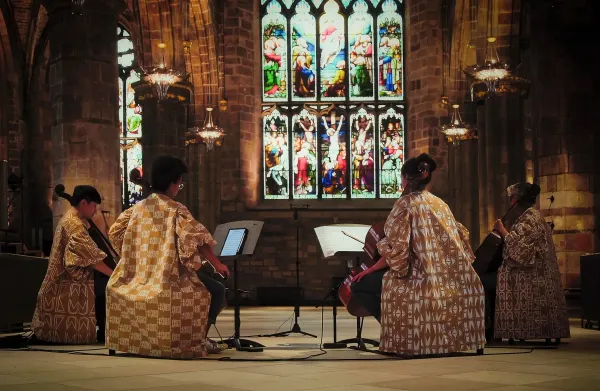
Obuyile
By Thulani Rachia | 2021Gadara (Jesus Casts Demons into Pigs) IV, 2026 by Rod Dee
Pencil on recycled paper.
30cm x 40cm
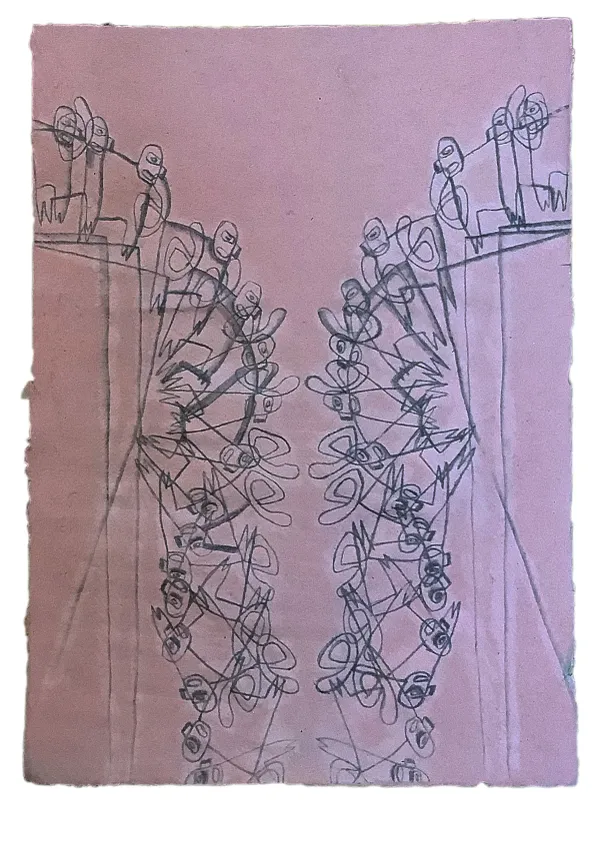
Gadara (Jesus Casts Demons into Pigs) IV
By Rod Dee | 2026Equation of Erosion, 2022 by Tahereh Asadi
This painting draws on another quatrain by Omar Khayyam, reflecting on the brevity of life through its three stages: birth, living, and eventual return to the soil from which we came. For me, this movement raises a painful question: if life is so short and suffering can be so consuming, what happens when we do not even have enough time to understand why we suffered, or why we found ourselves at the centre of this story? The figures move between states of presence and disappearance, allowing the same visual forms to be read in different directions — from birth towards death, or from death back towards birth.
Khayyam’s mathematical equations surround the poem, while Persian text occupies the centre and English translations appear across the four sections, bringing mathematical thought, poetry and lived experience together. The four sections follow the structure of the quatrain, with the figures becoming a visual interpretation of its story — a movement through birth, existence, suffering and disappearance. Equation of Erosion refers to the gradual wearing away of life itself and the unsettling possibility that we may disappear before we understand what our journey was for.
50cm x 70cm

Equation of Erosion
By Tahereh Asadi | 2022Published
Artists
Tags, Topics, Artforms, Themes and Contexts, Formats


Join Axis
We support artists
Funding, visibility, connection and practical help.
Membership includes £15 million of Public Liability Insurance!