The Blackening
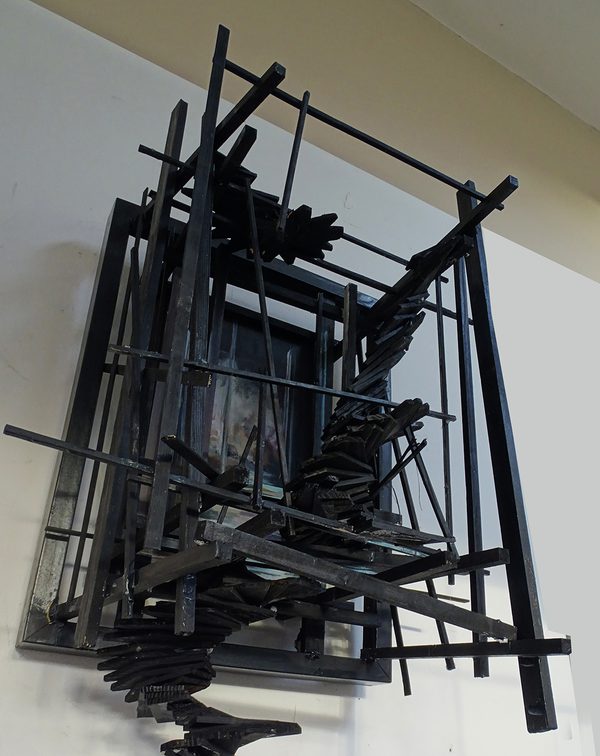
- Mixed Media
- Spiritual & Philosophical
- Personal Narratives & Identity
- Assemblage
- Acrylic Painting
- Conceptual
- Psychological
- Jungian Art
- Alchemy
Dimensions
60cm x 40cm x 50cm
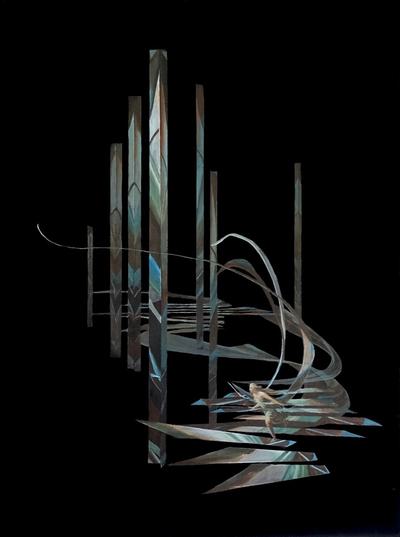
The Blackening began with the digital fragmentation of an earlier oil painting titled Zion 1989. Using this fragmented digital image as a reference, I created a small acrylic painting (30 cm x 20 cm). The addition of wooden batons extends the picture plane, which I associate with transcendence —the bridging of worlds —as the work transitions from two-dimensional to physical three-dimensional space. This process created an increasingly complex sculptural frame that protrudes from the picture plane into the viewer’s space, physically occluding and fragmenting the painting. A distorted spiral staircase, made of wood, permeates the structure, which precariously leans outward, inviting the viewer into an unstable space.
Painting the wood batons black in this work aligns with the initial alchemical stage of transformation, nigredo, the blackening phase associated with death and psychic dissolution. The blackened, fragmented, unstable structure symbolises a descent into the unconscious, a confrontation with the shadow, which precedes renewal and transformation. The precarious construction symbolises personal psychic collapse and engagement with the collective unconscious, a state of disorder that resonates with Jung’s concept of the archetypal apocalypse and the contemporary metacrisis.
Digitally fragmenting original paintings and translating them back into paint connects with Walter Benjamin’s discourse on the loss of aura in mechanical reproduction (Benjamin, 1935) and Jos De Mul’s extension of this concept to digital recombination (De Mul, no date). This layered engagement with authenticity, transformation, and multiplicity also resonates with Baudrillard’s concept of the simulacrum. (Baudrillard, 2019). Layered connections and works grow in complexity, where synchronistic unconscious entanglement between symbolic form and inquiry converges, guiding the development of my creative practice and research. My process also aligns with Deleuze and Guattari’s concept of the Rhizome, Deterritorialization, and Reterritorialization. (Gilman et al., 1989)
The construction of The Blackening emerged through an intuitive process and material experimentation. This work represents a symbolic threshold, a recurring theme representing a liminal and transitional space.
References
Baudrillard, J. (2019) Simulacra and simulation. Translated by S.F. Glaser. Ann Arbor, Mich: Univ. of Michigan Press (The body, in theory - histories of cultural materialism).
Benjamin, W. (1935) ‘The Work of Art in the Age of Mechanical Reproduction’.
Gilman, S.L. et al. (1989) ‘A Thousand Plateaus: Capitalism and Schizophrenia’, Journal of Interdisciplinary History, 19(4), p. 657. Available at: https://doi.org/10.2307/203963.
Jung, C.G. and Jung, C.G. (1977) Mysterium coniunctionis: an inquiry into the separation and synthesis of psychic opposites in alchemy. 2d ed. Princeton, N.J: Princeton University Press (The collected works of C.G. Jung, v. 14).
de Mul, J. (no date) ‘The work of art in the age of digital recombination’.


Join Axis
We support artists
Funding, visibility, connection and practical help.
Membership includes £15 million of Public Liability Insurance!