Phil Whiting
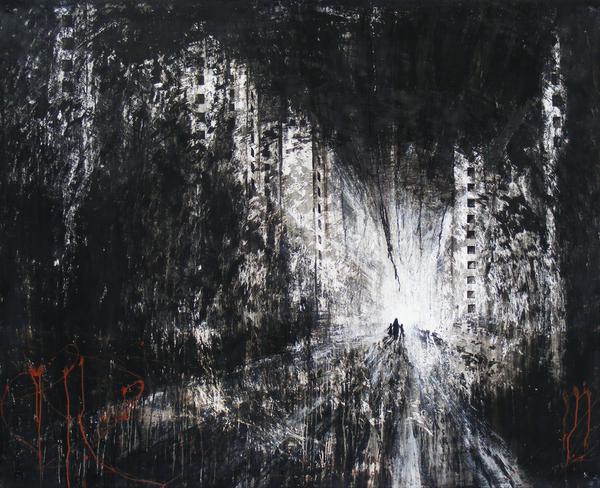
Personal summary: "Painting the land and evoking half forgotten memories and truths is the best way I know of exploring the human condition. I have long been drawn to places of trauma, be it abandoned post industrial sites or war zones. My feelings about the physical reality of what is left moves me to paint. I am in a sense a history painter".
Louise Bourgeois: “If your need is to refuse to abandon the past, you must recreate it”.
REVIEWS:
FROM THE FOREWORD BY THE REV DEAN SARAH BROWN IN THE EXHIBITION CATALOGUE FOR PHIL WHITING'S EXHIBITION ‘PLACES OF MOURNING IN THE WESTERN WORLD’ HELD IN HEREFORD CATHEDRAL IN 2022: “Hereford Cathedral is pleased that Phil Whiting agreed to exhibit his paintings which are such an articulate depiction of the terrible things that human beings can inflict on each other. As we host this exhibition atrocities of war and ethnic cleansing are taking place in Ukraine. Far across the world in Canada, the United States, Australia, and parts of Africa governments are facing up to what they did to indigenous groups. The attempted genocides in Bosnia and Rwanda are stark in the memory of many and the European trauma of the Holocaust still lives on in the minds, psyches and souls of survivors and their descendants. Wars, holocausts, and genocides can make us totally pessimistic about humanity, civilisation, politics, even the possibility of goodness. Phil Whiting has not averted his gaze from it all and has chosen to paint. In doing so he accepts that something can be done, that humans can be moved to do what is right, that we can be compassionate. That there is hope.”
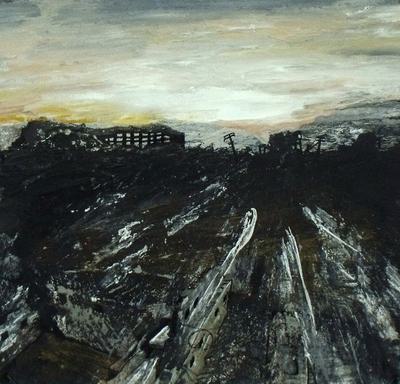
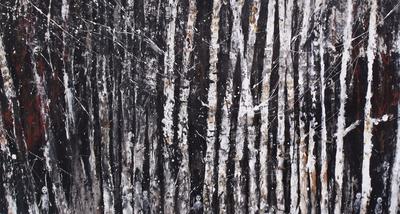
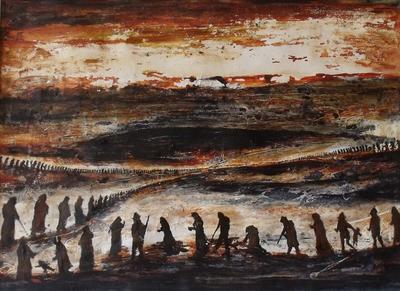
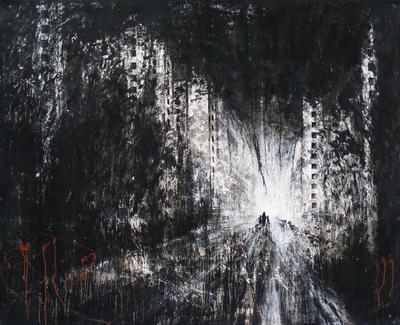
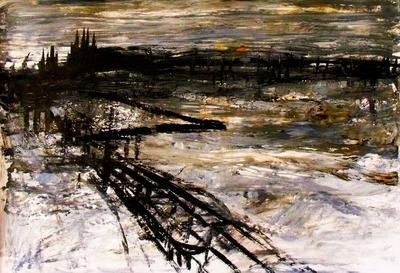
AXIS DIALOGUE ONLINE JOURNAL: ISSUE MARCH 2008 TO MAY 2008. This issue of Dialogue examines what it means to be a politically engaged artist. What, if any, are the criteria in the first place - and who sets them? How do artists balance competing factors of retaining a political edge and being free to pursue their own ideas, with the agendas of art institutions, funding bodies, and commercial galleries? This issue includes articles by Alex Rotas exploring the practice of ‘Performing Rights Glasgow’, Raimi Gbadamosi's interview with artists Margareta Kern and Grace Ndiritu, Emma Cocker's review of ‘Hidden Narratives’ at the Graves Art Gallery, Sheffield, and Peter Davies's article explaining that Phil Whiting's painted landscapes have an urgency that needs to be read and unravelled rather than simply received: ‘SREBRENICA: PAINTINGS FROM THE GRAVE’ at Cornwall Museum and Art Gallery, Truro, Jan - March 2008 Phil Whiting's exhibition first displayed at the European Parliament Building in Brussels in September 2006 belongs to a series entitled ‘Places of Mourning in the Western World’ based on Whiting's visits to and work from sites such as Ground Zero (World Trade Centre', New York), the Eastern European death camps and the Somme. The stark, harrowing images of places that have borne witness to recent human atrocities represents an ethical imperative that, together with Whiting's commitment to the social landscape as repository of human history, hits the viewer with a strongly - felt measure of both a moral and aesthetic nature. Whiting's artistic mission is therefore less overtly political than based on a philosophical desire to affect the senses and challenge the intellect. By facing up to human cruelty and the apathy or even duplicity of Western democratic powers during the mid 1990's Bosnian war, Whiting aims to create a kind of recognition, and with it redemption, for his audiences: “We must face up to our responsibilities," he explains, “So the grieving process can be experienced and we can move on.” In 2005 Whiting visited parts of Bosnia with Slovenian-born Miloska Nott and whose charity ‘Funds for Refugees in Slovenia’ offers practical support to war victims. This trip brought home to the artist the true scale and tragic legacy of the three - year Balkan conflict. Like Francis Bacon, whose raw expressionist vision of the human figure Whiting clearly admires and transforms into the very different context of landscape painting, Whiting uses emphatic distortion to dislodge normal channels of perception and creates an emotionally heightened idiom. This process requires not just artistic courage with the difficult and demanding medium of paint - and of charcoal and inks where the large drawings on paper are concerned - but increased empathy with the subject at hand. Whiting has an ability to directly engage with the plight of people, and is prepared to go to lengths to achieve this. For example, closer to home during the mid 1990s, in order to understand the real dangers that confronted Newlyn fishermen, having learnt to sail, Whiting went out in high seas. Similarly his ecologically conscious post-industrial Penwith landscapes depicting the ravages of tin mining sent him to inaccessible, even dangerous areas. However, by leaving a measure of ambiguity and mystery, his artwork is neither journalism nor political dogma - instead enabling the viewer to come to their own decisions. Whiting explained at a presentation that he gave at the Truro exhibition late January the importance of experiencing and transposing real emotion through his pictures. He spoke of excavating ‘the archaeology suffering’ from the prison camps, mass-grave sites or barren fields depicted in his near monochrome canvases. These rely not only on the seductions and side-effects of colour, but on the strong perspectives of, for example, ‘On the Wire’, ‘Through the Wire’ or ‘In the Women’s Block'. The linear scaffolding of barb wire fences, avenues and institutional corridors leading -literally and metaphorically - from darkness to the vanishing point of fierce daylight beyond the compound confines, structures the composition architectonically. The absence of humans bears a sombre message, and there is no artistic concessions of taste or an incidental or gratuitous prettiness to soften the impact of these images.
ALBUM COVER ARTWORK FOR ‘LAMENT&LIBERATION’ , THE CHOIR OF ST JOHN'S COLLEGE CAMBRIDGE, 2025. Editor's Choice, Gramophone Magazine, June edition 2025. “The cover artwork is by Phil Whiting, and is entitled ‘Sarajevo, Aleppo, Mariupol…the list goes on’. Christopher Gray (Director) encountered the work during an exhibition in Truro Cathedral and returned to it when seeking a suitable image for this album. He feels it confronts some of the worst horrors of humanity with the same uncompromising honesty as the music and poetry and is grateful to the artist for permission to use it in this context”.
CITATION ON WINNING THE RED LINE ART WORKS ANNUAL AWARD FOR 2017: "Phil's art incorporates big events and issues, their awful consequences and our responsibilities for them. His work raises tough questions about what we humans have done, what we have failed to do, what we have looked away from, who we really are, what we should be. This is rare and powerful art which penetrates and can leave its mark on us"
“Phil Whiting is a painter. His vigorous use of materials - acrylics (in thick striated impasto) inks, charcoal (ground and smeared) applied with brush, knife and 'whatever'- recalls a terrain smarting from the brute force of man's misuse of it. This is not the celebrated picturesque Cornwall we so often see but its dirty, rain-soaked underbelly, a landscape left bereft by voracious mining and haphazard industrial development. Work from Bosnia (his exhibition 'Srebrenica' transfers from the European Parliament Building to the Royal Cornwall Museum in the Spring) is also included - landscapes whose brutal past is etched into their future reminding us of the horrors mankind is capable of creating for itself”. Pip Palmer, Galleries Magazine, Jan. 2007.
“Predominately black and white, they're built up with thin layers of watery paint that Whiting has splashed, dripped and poured onto the paper using expressive, gestural marks verging on abstraction. Up close, these large paintings are a confusing jumble, as if looking through a mud-spattered window. It's only when you step back, viewing from a distance, that their full power is appreciated. One of the most arresting is 'The Place of Sorrow'. Though the location is not disclosed, its sweeping panoramic view and dramatic sky is incredibly striking. 'Destroyed Muslim Houses Near Srebrenica' is another powerful, psychologically charged work contrasting sharply with the images of Cornwall such as 'Tin Mine Wasteland' or the painting of St StIthians Church, its tower just visible in the distance through the drips of paint. Hard-hitting and thought-provoking, this exhibition leaves a lasting impression.” David Trigg's review of ‘Philip Whiting’ at the BayArt Contemporary Art Gallery Cardiff, Metro, August 2008. Metro rating 4* out of 5*.
"One of our most powerful painters. Haunting, brooding and sublime". Frank Ruhrmund, review of Phil Whiting's 'Landscape and Memory' exhibition at the Belgrave Gallery, St Ives Times & Echo, 2nd March, 2012.
“I own a wonderful picture of Geevor Mine in Cornwall by Phil, it has a haunting quality to it - but the ghosts of Geevor are not the ghosts of Srebrenica and I hope these paintings will provoke and prevent us forgetting.” Hugo Swire MP (later Lord Swire and former Minister of State for Europe and the Americas) extract from his foreword in the exhibition catalogue for Phil Whiting's exhibition ‘Srebrenica, Paintings from the Grave’ held in the Yehudi Menuhin Space, The European Parliament Building, Brussels, in 2006.
Influences: Very early on American Abstract Expressionism was important to him, especially Marc Rothko and belatedly Louise Bourgeois in who's work he discerned a profound concern with the human condition, a concern that has resonated within him throughout his career. This was enriched by his re-discovery of David Bomberg and Frank Auerbach (around 1971) and Paul Nash. In the early 80's he also found affinity with German Neo-Expressionism. He reads Modern History avidly and believes that his generation can provide that essential bridge of knowledge/experience between World War 1 and the uncertainties of today.
Career path: Born London 1948. Some earliest memories were of bomb sites seen from push chair ("I suspect these early memories have shaped the way I have viewed the world ever since"). Grew up in Hull. Left school at 15. Studied Art at Newcastle (Bath Lane), Portsmouth and Falmouth Colleges of Art. Hitch hiked across Europe to former Yugoslavia in 1968 showing solidarity with the 'Student Movement' and 'Prague Spring' ("probably my one real achievement whilst a student at Portsmouth College of Art"). In 1974 worked in a psychiatric hospital near Leicester where he met aged survivors of the 'Great Sleeping Sickness Epidemic' which ravaged the West in the early 1920s. In 1977 he met aid workers working for an NGO in Palestine which left him uneasy by the post colonial approach of Western powers which seemed little more than pursuing a self serving policy of immediate political expediency. Received a supportive letter from Noam Chomsky. In 1980 equipped with a sketchbook journal (a format he would from then on adopt for his many travels across the world) he travelled the length of the former Yugoslavia just after Tito died in Spring 1980: "People extremely apprehensive about the future." In 1981 he travelled around America visiting 19 States and crossed the border into Mexico. He became deeply disturbed by witnessing the negative effects that the U.S. policy of marginalizing indigenous groups such as the Navajo and the Hopi can have on a people's identity, memory and historical narrative. He felt that in a more compassionate and imaginative world it could work both ways in that both the majority group and the minority group could learn from one another and by so doing enrich humankind's understanding of the world and our place in it. On returning to England he became determined more than ever to become a history painter in the landscape tradition believing that painting can best awaken and speak truth to power directly to a wider audience than can the spoken word. During the summer of 1985 he recognised he was beginning to suffer from the mental disorder PTSD which had developed after a girl friend and her 6 year old twin boys were callously gunned down. After seeking help he found catharsis by using his art practice to explore such areas as the aftermath of extreme violence and war. He reallocated to Cornwall in February 1989 and embarked on a series of paintings (Landscape and Memory) inspired by Cornwall's dying rich post-industrial past. Concurrently in April 1995 at the height of the Bosnian war and whilst Co-director of a painting school in S.W. France he visited Oradour-sur-Glane with students. So moved with what he saw and disturbed by the genocidal behaviour once again taking place in the heart of Europe when we were promised ‘Never Again’ he made plans for a major project to visit sites of C20th (and later sadly C21st) trauma throughout Europe and the Middle East (later to include New York and further afield across Asia) in an attempt to find answers. His Project became known as 'Places of Mourning in the Western World'. Soon after visiting the death camps in Spain and Poland in 2005 he was commissioned to accompany the NGO 'The Fund for Refugees in Slovenia' to Bosnia to bear witness to the aftermath of genocide as a war artist. This culminated in his residency and solo exhibition 'Srebrenica: Paintings from the Grave' held in ‘The Yehudi Menuhin Space’ in The European Parliament Building, Brussels in 2006. Since then he has been invited to give talks and exhibit his work at many institutions including Truro Cathedral, The RCM, Oxford University, Leigh Day Human Rights Law Firm London, Hereford Cathedral, The BayArt Contemporary Gallery Cardiff, Cardiff University, The Terry Frost Gallery King's School Worcester, Monmouth School, The Sewell Centre Gallery Radley College, etc, and has received commissions for his work by organisations and institutions such as The Guardian, English Heritage, Amnesty International, Oxford University, Cambridge University, Truro Cathedral, etc.
He relies solely on sponsorship and sales to finance his work which in turn has raised tens of thousands of pounds and awareness for good causes.
Phil continues to paint and travel extensively in his search for subject matter. In recent years he has embarked on many overland painting expeditions accompanied by his wife Emma travelling through such places as the Balkans, Central and Western Europe, Siberia, Mongolia, China, Nepal, the Middle East, Moroccan Sahara, the Arctic Circle, New Zealand and Australia.
FURTHER REVIEWS:
“Haunting paintings”. Lee Trewhela, editor Arts and Leisure, West Briton Newspapers, 2005.
“Here, I feel, is an artist who takes as a start important historical subjects and events and transmutes and transforms them, in his personal way, into poetical and magnificent paintings.” Roman Halter, artist and Holocaust survivor, extract from his foreword in the exhibition catalogue to Phil Whiting's exhibition ‘Srebrenica, Paintings from the Grave’ held in the Yehudi Menuhin Space, European Parliament Building, Brussels in 2006.
“Sombre but necessary paintings - testimony of an immutable recent history". Professor Paul Gough, artist, academic and author, extract from his foreword in the exhibition catalogue to Phil Whiting's exhibition ‘Srebrenica, Paintings from the Grave’ held in the Yehudi Menuhin Space, European Parliament Building, Brussels in 2006.
“Lovely drawings". Artist Alexander Mackenzie's response on seeing Whiting's graphic work in the Rainyday Gallery, Penzance in 1993.
“I particularly like Phil Whiting's Old Engine House”. ArtReview Magazine editor David Lee's response in ArtReview Magazine, November 1994 on seeing Whiting's painting during his visit to ‘The Beatrice Royal Art Gallery’, Eastleigh, Hampshire, in 1994.


Join Axis
We support artists
Funding, visibility, connection and practical help.
Membership includes £15 million of Public Liability Insurance!